
The line “history doesn’t repeat itself, but it often rhymes” is widely attributed to Mark Twain, although he apparently never said it.
Either way, it feels appropriate today.
We’ve seen versions of this movie before: the railroad mania of the 19th century, the electrification boom of the early 20th century, the automobile, and, more recently, the dot-com bubble.
Each began with a genuinely transformative technology. Each attracted enormous amounts of capital. Each inspired predictions that the world was about to change forever.
And each produced a bubble.
It may be fashionable to compare today’s extraordinary investment in artificial intelligence with these earlier technological revolutions. There is good reason to do so. The amount of capital flowing into AI infrastructure is already enormous, measured in hundreds of billions of dollars annually, and it continues to grow. Data centers, GPUs, power generation, transmission capacity and networking infrastructure are being built at a pace that would have been difficult to imagine only a few years ago.
In that sense, AI looks remarkably familiar.
But it is also markedly different.
The buildout is happening extraordinarily quickly. Railroads, electrification and the automobile unfolded over decades, giving companies, investors, governments and consumers time to adapt. The modern AI investment cycle has compressed an enormous amount of capital formation and technological progress into just a handful of years.
The investment is also highly concentrated. A relatively small number of companies are committing extraordinary sums of capital in a race to buildever-larger models and the infrastructure required to support them.
And unlike many previous technological revolutions, AI has the potential not simply to create new industries, but to reshape the economics of existing knowledge work. The productivity benefits could be profound. So could the disruption.
All of which makes history useful—but imperfect.
One of the most useful frameworks for thinking about this moment comes fromeconomist Carlota Perez.

Perez’s seminal 2002 book, Technological Revolutions and Financial Capital, examined the major technological revolutions dating back to the Industrial Revolution. She found that despite enormous differences in technology, these revolutions tended to follow a surprisingly consistent pattern.
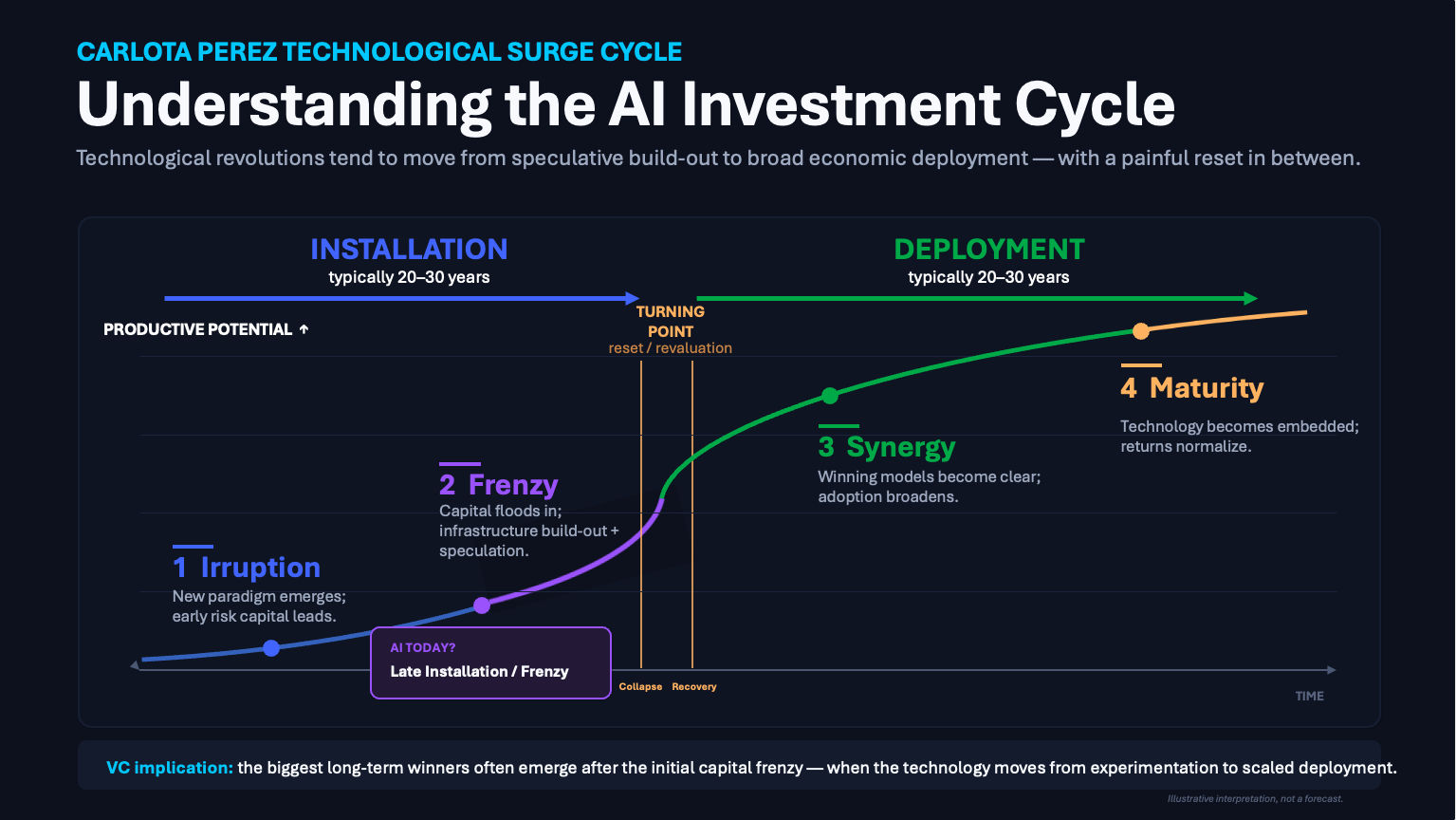
First comes what Perez calls the Installation Phase.
A breakthrough technology emerges. Entrepreneurs rush in. Financial capital follows. Infrastructure gets built. Expectations rise. Investment accelerates.
And eventually, capital begins moving faster than economics can justify.
Railroads laid too much track. Telecommunications companies buried too much fiber. Dot-com companies raised money despite having little revenue and, in some cases, barely a business model.
From the perspective of investors at the peak, much of this capital was ultimately destroyed.
But Perez made a more interesting observation: the investment itself was not necessarily wasted.
The speculative bubble financed the infrastructure required for the next stage of the technological revolution.
Perez calls that second period the Deployment Phase.
After the bubble breaks, capital becomes more disciplined. Technologies mature. Costs fall. Business models improve. And entrepreneurs begin building sustainable businesses on top of infrastructure someone else has already paid to create.
The railroad bubble left behind railroads.
The automobile boom left behind roads, factories, supply chains and mass-production techniques.
The telecom and dot-com bubbles left behind enormous amounts of fiber-optic infrastructure, computing capacity and technical talent.
The companies that ultimately captured the greatest value were not necessarily the ones that raised the most money during the frenzy. Many emerged—or accelerated—after the economics of the underlying technology had dramatically improved.
That framework feels particularly relevant to AI.
We appear to be living through an extraordinary Installation Phase.
Capital is pouring into foundation models, semiconductors, data centers and energy infrastructure. Model performance continues to improve. Compute requirements continue to rise. Frontier AI companies are being valued at levels that would have seemed extraordinary even a few years ago.
Whether those economics are sustainable is a different question.
It is entirely plausible that the cost of intelligence falls dramatically from here.
Models may increasingly commoditize. Open-source and smaller models may become “good enough” for an enormous percentage of applications. Token costs could continue collapsing. Computing infrastructure may become abundant relative to demand.
We have seen this before.
There was a time when consumers paid close attention to the processor inside their computer. Every new generation offered a meaningful improvement, and Intel’s latest chip was a central part of how PCs were marketed.

Today, almost nobody asks which processor is inside their laptop.
The technology became sufficiently powerful, sufficiently inexpensive and sufficiently ubiquitous that it faded into the background.
AI may eventually follow a similar path.
And if it does, that could be extraordinarily good news for entrepreneurs.
The enormous investments being made today do not disappear if financial returns disappoint. The data centers remain. The chips remain. The research remains. The models remain. Most importantly, the knowledge gained by tens of thousands of engineers and entrepreneurs remains.
The infrastructure created during the speculative phase can become the raw material for the deployment phase.
I have no idea whether we are approaching Perez’s “turning point.” I don’t know whether it arrives through falling model prices, consolidation among AI companies, a correction in private-market valuations, a broader public-market reset—or some combination of all four.
Anyone who claims to know probably has more confidence than evidence.
But if AI is truly one of the defining technological revolutions of our lifetime (and I believe it is) then at some point we should expect the economics to transition from installation to deployment.
And history suggests that transition may be uncomfortable.
Bubbles eventually run into economic gravity. Companies fail. Capital gets repriced. Business models that worked when money was abundant stop working when investors begin demanding returns.
But that is not necessarily where the story ends.
In many technological revolutions, it is where the most interesting part of the story begins.
The lesson I have taken from previous technology cycles is not to avoid transformative technologies because they attract too much capital. Nor is it to assume that every company associated with a transformative technology will succeed.
It is to remain patient.
Because some of the most compelling opportunities appear after expectations reset, infrastructure has been built, costs have fallen and entrepreneurs can suddenly build businesses that would have been economically impossible just a few years earlier.
Bubbles destroy capital.
But they also build the foundations of the future.
And if history does rhyme, the era after today’s AI investment frenzy mayprove to be one of the most interesting periods to invest in it.
