
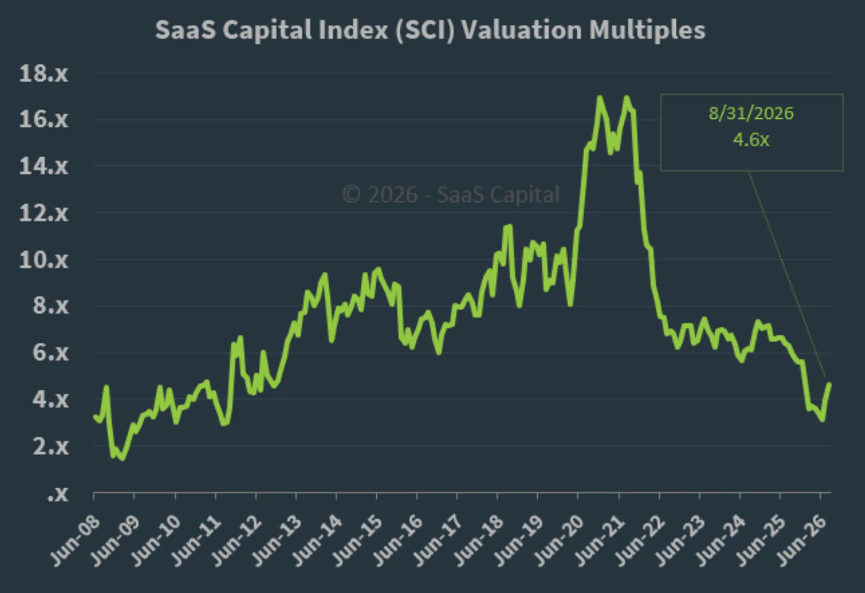
As SaaS companies became some of the most sought-after investments in technology, valuations rose accordingly. High gross margins, rapid revenue growth, and an inherently scalable business model helped push valuations to 16.5 times forward revenue back in 2021.
And within B2B software, one position was particularly coveted: the system of record.
A system of record stores and governs a company’s critical data—its accounting, transaction, customer, or employee records. Depending on the business function, that role typically belongs to an enterprise resource planning (ERP), customer relationship management (CRM), or human resources platform.
The defining characteristics are straightforward: an authoritative source of trusted data, tightly controlled access and editing permissions, and integrations that allow other applications to read, update, or synchronize information.
In the SaaS era, becoming the system of record was the ultimate ambition for many software companies. Own the system of record, and you owned the foundation on which a company’s workflows depended.
Other applications integrated with you. Processes were built around you. Employees were trained to use you.
The result was a deep, defensible moat—and the attractive economics that came with it.
Once hundreds of workflows and applications depended on that foundation, replacing it became an enormous undertaking. It meant migrating critical data, rebuilding integrations, redesigning processes, and retraining employees. For many customers, the cost and disruption simply weren’t worth it.
But what happens when AI changes both how software is built and how people use it?
Software development is becoming more accessible. Customers can increasingly “vibe code” their own applications, while entrepreneurs can more easily build products that challenge incumbents.
That raises a fundamental question: If owning the system of record created the moat in SaaS, what creates an equally defensible position in the AI era?
We believe we’re moving toward a future in which employees no longer need to log in to a collection of SaaS applications to get their work done. No more constant toggling between browser tabs. No more manually moving information from one disconnected system to another.
In our travels, we’ve seen employees juggling seven open browser tabs, repeatedly copying and pasting data between applications that don’t communicate with one another.
The employee has effectively become the integration layer.
Agentic AI offers a different model.
Rather than opening multiple dashboards to retrieve information, update records, or initiate workflows, employees will use a single, simpler interface to tell an agent what they need. The agent will then interact with the underlying systems through APIs (or the equivalent), accessing their data and business logic directly.
The question is no longer just whether SaaS applications will incorporate AI. It’s whether employees will need to open those applications at all.
For many routine workflows, the dashboard could become a legacy interface rather than the primary place where work happens. The underlying data and business logic would remain essential. The traditional front-end experience might not.
It’s an exciting possibility: separating the systems that store data and run business processes from the interface employees use to get things done.
For automotive dealers, the stakes are significant. Dealer management systems (DMS) and CRMs—the dealership’s core systems of record—together account for almost half of current dealer SaaS spending, as the accompanying chart illustrates.
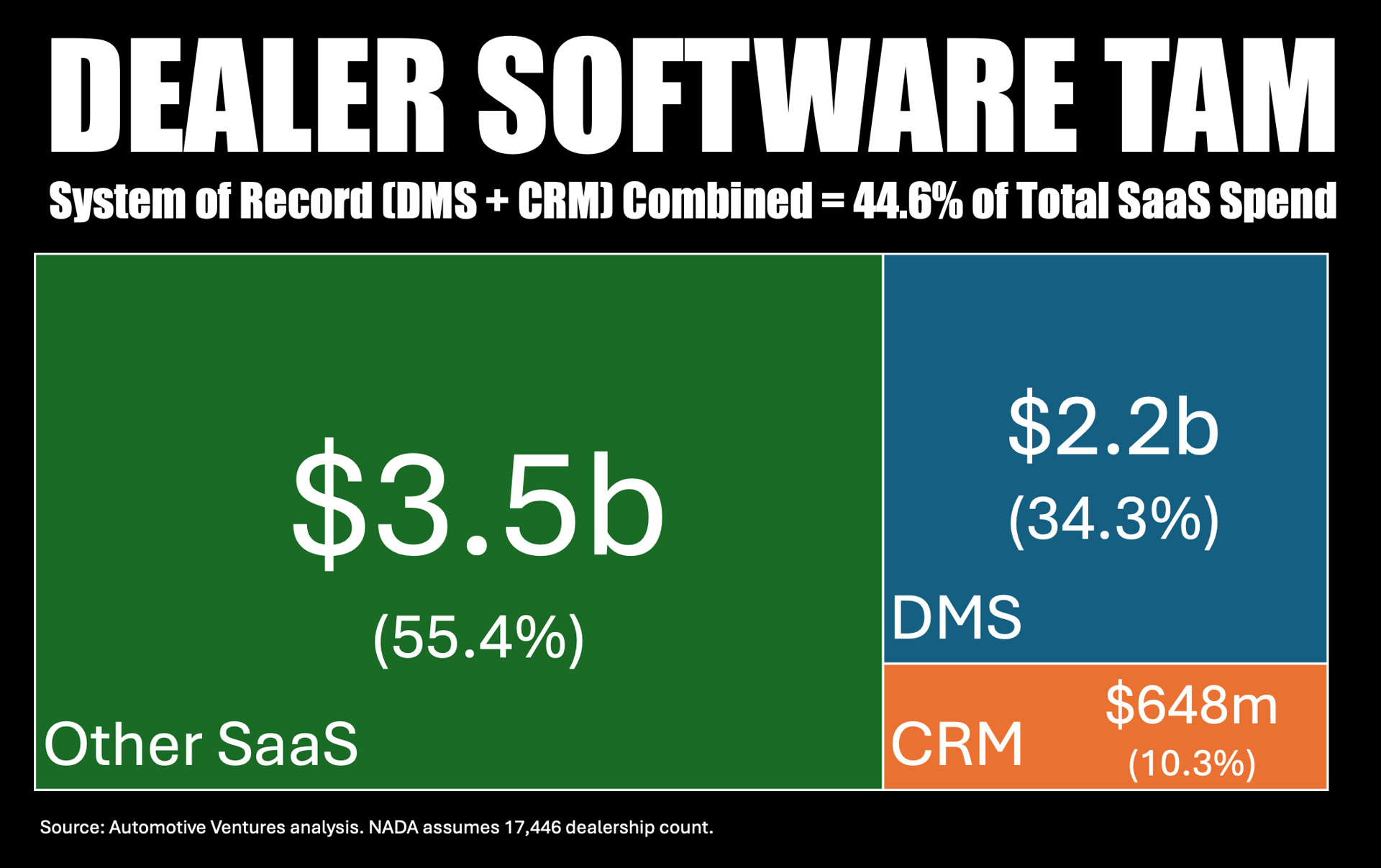
Will that revenue become more or less defensible as fewer users interact with those systems directly?
Businesses will still need assurances that their data is available, secure, and accurate. They will still need trusted records, access controls, and reliable business logic. Those requirements don’t disappear simply because an AI agent becomes the interface.
But the systems that store the data may no longer own the user experience.
That distinction could have profound implications for their competitive position, pricing power, and ability to deliver and capture value. A system of record might remain indispensable to a business while losing some of the influence that came from being the place where employees spent their working day.
In the SaaS era, the prize was owning the record.
In the AI era, will the prize be owning the work?
